
Signed in as:
filler@godaddy.com
Coercive and controlling behaviours affecting children do not look the same in every family. Some behaviours may occur occasionally during periods of distress, poor judgement or conflict and do not develop into an ongoing pattern. In other situations, behaviours are repeated, become increasingly restrictive and begin to affect multiple areas of the child’s life, relationships and sense of safety.
The same behaviour can carry very different significance depending on how it occurs and what surrounds it. One frustrated comment about another parent is different from repeated denigration over months or years. A missed telephone call is different from an ongoing pattern of preventing communication. Seeking help from a school or professional because of a genuine safety concern is also different from repeatedly involving services in ways that are intended to discredit, exclude or control another person.
Looking at the broader pattern helps distinguish isolated, reactive or poorly managed behaviour from conduct that is becoming persistent, restrictive and coercive.

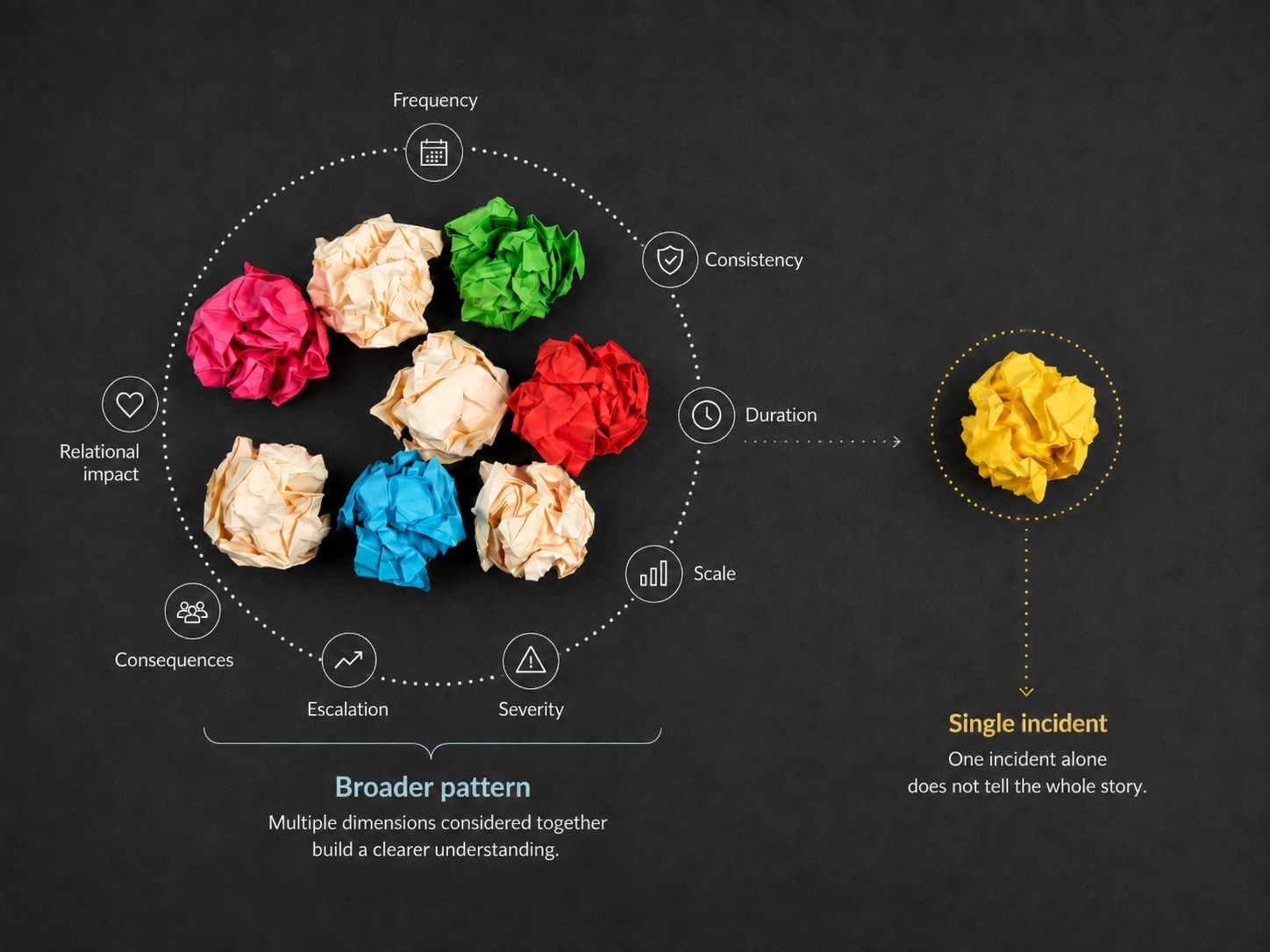
Several dimensions can help build a clearer picture of how extensive and serious the behaviour has become. Considered together, they allow individual incidents to be understood as part of a broader pattern, including how long it has continued, how widely it reaches into the child’s life and what consequences are developing for the child and others involved. They are not intended to function as a scoring system or numerical measure of severity.
Frequency refers to how often the same or similar behaviours occur. An isolated incident may have limited influence, while repeated messages or consequences can gradually become part of the child’s everyday relational environment.
For example, concern increases when a child repeatedly hears that another parent or family member cannot be trusted, does not really care about them, is responsible for the family’s problems, or should not be spoken about positively. The significance lies in the repetition and the cumulative message the child is receiving, rather than in one statement considered alone.
Consistency looks at whether different behaviours are repeatedly moving in the same direction. A person may not use the same tactic every time. The child might experience criticism on one occasion, guilt on another, restrictions on communication later, and disapproval when they express affection. When these different behaviours consistently encourage distrust, alignment, avoidance or rejection of the same person, they may form part of one broader pattern.
Duration considers how long the pattern has continued and whether the child has had repeated exposure to it. Patterns operating over a short period may affect a child differently from those continuing across months or years.
As the pattern becomes familiar, children may begin adapting without being directly instructed. They may stop mentioning enjoyable experiences, avoid asking to contact someone, hide affection, avoid particular topics or anticipate an adult’s reaction before deciding what to say. What began as external pressure can gradually become part of the child’s own way of managing relationships.

Scale refers to how many areas of the child’s life and relationships have become affected. A limited pattern may remain within adult communication. A broader pattern may begin to shape the child’s contact, schooling, health care, extended family relationships, community connections and involvement with professional or legal systems.
Severity is not determined by the number of behaviours alone. A small number of high-impact tactics can carry more serious consequences than a larger number of lower-level behaviours. The focus should be on the degree of pressure, fear, emotional burden or loss created for the child and others.

Escalation can be seen when behaviours become more frequent, restrictive, serious or consequential over time. What begins as criticism, gatekeeping or subtle loyalty pressure may develop into stronger demands for alignment, tighter control over communication, increasing claims that another person is unsafe, greater involvement of professionals or authorities, refusal of contact, and eventually substantial or complete loss of a relationship.
The consequences may also broaden as the pattern develops. Matters initially confined to the family can begin to affect schooling, counselling, child protection, protection-order proceedings, police involvement or family law matters. Looking at the chronology helps show whether seemingly separate events form part of an intensifying pattern, and whether each development is increasing the pressure on the child or the consequences for others involved.
When concerns are raised about behaviour affecting a child, the response can help show whether the conduct is situational and open to change or part of a more entrenched pattern. Reflection, acknowledgement of the impact on the child and sustained behavioural change indicate a capacity to reduce the pressure being placed on them.
Continued behaviour after concerns have been clearly raised can increase concern about the seriousness of the pattern, particularly where the effects on the child are dismissed, responsibility is repeatedly shifted to others, agreed boundaries are ignored, or the conduct becomes more restrictive after intervention. How the person responds to feedback can help show whether meaningful change is occurring or whether the behaviour is becoming more entrenched despite growing evidence of its effects on the child.
Children are not always passive observers of coercive family dynamics. Over time, they may begin participating in behaviours that support or reinforce the pattern. Their involvement can have serious consequences, while still developing within relationships in which they depend on adults for safety, approval, belonging and emotional security.
A child can become an active participant without being the architect of the family dynamic. Their behaviour may be shaped by dependency, repeated messaging, reinforcement, fear, loyalty pressure or the need to preserve security within an important relationship. Their participation should therefore be understood within the context in which it developed, rather than assigning adult motives or responsibility to the child because their actions have significant consequences.
In more serious circumstances, a child may become involved in allegations, complaints, reports to professionals, recordings of interactions or accounts given to child protection, police or other authorities. What begins within the family can then extend into child protection involvement, protective proceedings, police investigations or criminal charges against another person.
Genuine disclosures of abuse or danger must always be responded to appropriately. Where the broader pattern also raises concerns about coercive influence, careful consideration may be needed of how the child’s account developed, what information they had been exposed to, whether they had been repeatedly questioned or encouraged to gather information, and what pressures or relational consequences surrounded their involvement.
Coercive family dynamics can extend beyond the home and involve people or organisations with considerable influence over the child’s life. External involvement is often appropriate and necessary, particularly where genuine concerns about abuse, neglect or family violence have been raised. The presence of a school, counsellor, police officer or court process is not evidence of coercive control in itself.
The relevant question is not simply whether another person or organisation became involved. Consider how the involvement arose, what information was provided, whether relevant competing information was considered, and what consequences followed for the child and their relationships.
The seriousness of a pattern is partly reflected in the consequences it produces. Counting behaviours alone can be misleading because a small number of high-impact tactics may cause substantial harm, while numerous lower-level behaviours may become significant through repetition and cumulative effect.
Impact should therefore be considered in terms of both immediate consequences and the way the pattern changes circumstances over time. Some effects are temporary or reversible, while others can alter relationships, decision-making, access to support or the course of family and legal processes in ways that are much harder to undo.
The child’s experience should remain central. Changes may appear in emotional wellbeing, attachment, behaviour, beliefs, identity, family connections and the amount of freedom the child has to maintain relationships without fear or pressure.
Where relational pressure becomes entrenched, some children may develop coerced alignment, attachment deactivation or Survival-Based Rejection. No single presentation establishes that coercive control is occurring; the meaning lies in the broader pattern and the pathway by which the child’s relationships and behaviour changed.
Consequences for the parent or family member whose relationship is being affected may extend far beyond reduced contact. The scale of these consequences is relevant when considering how far the coercive pattern has reached.

Relational freedom refers to the child’s ability to have their own thoughts, feelings and relationships without needing to organise them around another person’s fear, grievance or expectations. Increasing restriction in these areas can be an important indicator of how deeply coercive dynamics are affecting the child.
Can they say they love, miss or enjoy time with someone without guilt, fear, disapproval or pressure to withdraw what they have said? Notice whether affection towards one person appears to create emotional consequences in another relationship.
Can they recognise both positive and difficult experiences with the same person, or do their views become unusually rigid, with one person described as entirely good and another as entirely bad? Healthy relationships usually allow room for ambivalence and complexity.
Can they hold a different opinion from an influential adult without fearing anger, rejection, withdrawal of affection or loss of belonging? A child’s autonomy is restricted when disagreement carries a relational cost.
Can they speak with safe family members, share ordinary information and maintain contact without being monitored, questioned afterwards or made to feel responsible for another person’s reaction?
Are they able to develop their own understanding of a parent or family member through what they personally see, hear and experience, or are they expected to adopt another person’s interpretation of events and relationships?
As children grow, gather new information and have different experiences, can their views evolve without being treated as disloyal, manipulated or unsafe? The ability to revise a view is an important part of developing independent judgement.
Can relationships with siblings, grandparents, cousins and other extended family members continue where those relationships are safe and beneficial, or does rejection of one person gradually extend to others associated with them?
Children need to be protected from relationships that are genuinely harmful or unsafe. They also need protection from coercive narratives and behaviours that progressively recast a safe or sufficiently safe relationship as dangerous, harmful or untrustworthy without a corresponding basis in the child’s direct experience.
Restricting contact, reporting concerns, involving professionals or seeking legal protection may be entirely appropriate when a child is at risk. None of these actions should be treated as evidence of coercive control simply because they affect another parent or family member. Concern arises when conduct forms part of a broader pattern of pressure, distortion, unnecessary restriction or control.
A clearer distinction comes from looking at the whole pattern: what prompted the concern, whether actions were proportionate to the information available, what the child directly experienced, how their views and relationships changed over time, and whether they remained free to experience safe relationships for themselves.
No single behaviour, allegation or incident tells the whole story. Understanding the seriousness of coercive control affecting a child requires attention to the cumulative pattern and to what that pattern is doing to the child’s relationships, autonomy, safety and development.
Frequency • Consistency • Duration • Scale • Severity • Escalation • Systems Involvement • Consequences • Relational Restriction
Together, these dimensions help distinguish behaviours that are limited or short-lived from patterns that are persistent, increasingly restrictive or carrying serious consequences. They are intended to support understanding of the overall dynamics, not to function as a numerical assessment scale or as a label applied to a parent or child.

We are calling for Australian law to recognise and respond to child coercive control and alienating behaviours as serious forms of psychological abuse and family violence, particularly where children are manipulated into rejecting safe relationships or where legal and protective systems are misused to intensify that harm.